Showing posts with label tone. Show all posts

22 February 2025

Misrepresenting Cléirigh's Model As The Authors' Innovation

Ngo, Hood, Martin, Painter, Smith & Zappavigna (2022: 207):

As reviewed in Section 7.1, our project involves developing paralanguage as a semiotic system alongside language. We adopted our model of the relation of paralanguage to language from earlier work on the convergence of language and image in children’s picture books (Painter et al., 2013). As outlined in Table 7.1, sonovergence was explored in terms of how linguistic and paralinguistic systems resonate with one another (interpersonal meaning) and sync with one another (textual meaning).


Blogger Comments:

This is very misleading indeed. The origin of the notions of gestures being in tune with TONE, and in sync with TONICITY and RHYTHM is Cléirigh's model (2009), which predates, by four years, the "earlier" work on the convergence of language and image in children’s picture books (Painter et al., 2013):

The plagiarism in this work is effected through myriad small steps with Martin, the author of this chapter, the driving force.

29 January 2025

Some Problems With Paralinguistic Macro-Theme

Ngo, Hood, Martin, Painter, Smith & Zappavigna (2022: 191, 192):

In example (23) we move up one level in the hierarchy of periodicity from the hyper-Theme to the macro-Theme that immediately precedes it.

Sonovergently, the lecturer takes three steps in sync with three silent beats prior to the commencement of the macro-Theme in (24). This takes him from a space on the left to reach the central desk. Synchronous with the commencement of the macro-Theme, the last one is the distal convoluted tubule, he takes off from this central position, moving to the right. On completion of the macro-Theme, he rotates his body 180° to face left and continues stepping backwards in sync with the two silent feet that precede the hyper-Theme. 
This sequence of movement and body orientation is depicted in Figure 6.7. The lecturer ends up on his ‘launch pad’, the position from which he delivers his hyper-Theme before taking off in sync with a new phase of discourse.

The body movement and thematic development are well coordinated. Footfalls in Figure 6.6 synchronise with clause-level Themes and anticipatory positioning scaffolds higher levels of Theme – the lecturer’s positioning to the right of the lecturing space syncs with the hyper-Theme and centre-stage (desk) positioning syncs with the macro-Theme.


Blogger Comments:

[1] To be clear, 'macro-Theme' is Martin's rebranding of the 'Introductory Paragraph' of writing pedagogy as linguistic theory. As linguistic theory, macro-Theme, like hyper-Theme, is a function without a structure: there is no 'macro-Rheme'; that is, there is a point of departure for the message, but there is no body to the message.

As previously explained, 'hyper-Theme', a term coined by Daneš  for a Theme that is later repeated, is Martin's rebranding of the 'Topic Sentence' of writing pedagogy as linguistic theory. As linguistic theory, hyper-Theme is a function without a structure: there is no 'hyper-Rheme'; that is, there is a point of departure for the message, but there is no body to the message.

[2] To be clear, given the contrastive newness of last, and the fact that tone 3 alone misrepresents this statement as tentative, a more likely analysis of this tone group is
//3 ‸the / last one is the //1 distal / convoluted / tubule //
[3] To be clear, here the authors are merely describing how the lecturer moves while delivering this part of his lecture. Merely occupying a space before moving off does not highlight what is being said. And what is first said need not be a "macro-Theme". That is, no realisation relation has been established between "macro-Theme" and body location: a body location does not specify a "macro-Theme" and a "macro-Theme" does not specify a body location.

[4] As previously demonstrated, the relevant footfalls in Figure 6.6 coincide with the Focus of marked New information.

21 January 2025

The Unacknowledged Information Unit

Ngo, Hood, Martin, Painter, Smith & Zappavigna (2022: 187):

It is important to recall here that clause and tone group may or may not map onto each other (Chapter 3), as evident in (19) and (19'). In (19) the underlining in each clause specifies Theme. However, New is specified in the tone group as the tonic syllable that composes phonological prominence through the major pitch movement of the tone group. This is shown in bold italics in (19').


Blogger Comments:

[1] This confuses content with expression. To be clear, New is a function in the structure of an information unit. A tone group realises an information unit, and its tonic realises the Focus of New information. It will be seen later that an explicit recognition of the information unit makes the problems with PARALINGUISTIC PERIODICITY more obvious.

[2] This confuses TONICITY with TONE. To be clear, the tonic syllable doesn't "compose" phonological prominence through the major pitch movement. The tonic is distinguished in terms of relative loudness ± duration. It is the pitch movement at the tonic that identifies the tone of the tone group.

17 January 2025

Misunderstanding Textual Prominence

Ngo, Hood, Martin, Painter, Smith & Zappavigna (2022: 183, 184):

A paralinguistic beat can also give prominence to interpersonal meaning. The hand beat in image 5 of (17'') not only syncs with the final tonic segment form, but its low-falling trajectory is interpersonally ‘in tune with’ the major pitch contour of a falling tone 1 (see Chapters 3 and 5) – prominence is thus added to the meaning of this tone (here, providing information). 


Blogger Comments:

[1] To be clear, because the hand beat serves the same linguistic tonicity, it gives prominence to whatever metafunctional meaning it highlights as the New element of an information unit.

[2] To be clear, form is the tonic syllable, not the tonic segment. The tonic segment begins with the tonic foot and includes all subsequent feet in the tone group.

[3] To be clear, the direction of a beating gesture does not distinguish tones. For example, there is no rising beat for tone 2, no level beat for tone 3, no fall-rise beat for tone 4, and no rise-fall beat for tone 5. A downward movement is the default direction, regardless of the tone.

[4] This confuses the textual function of TONICITY with the interpersonal function of TONE. The choice of tonic prominence realises the choice of New information, whereas the choice of tone realises the choice of KEY for a given choice of MOOD. The choice of tonic gives prominence to an element of structure, not to the choice of tone.

[5] This confuses SPEECH FUNCTION (semantics) with KEY (lexicogrammar). 'Giving information' (statement) is SPEECH FUNCTION, and it is realised in the grammar by MOOD. The system of TONE, on the other hand, realises the system of KEY for a given MOOD.

11 January 2025

Problems With The Authors' Intonational Analysis

Ngo, Hood, Martin, Painter, Smith & Zappavigna (2022: 182):

In the unmarked case, salient syllables highlight content words (not grammatical ones) and assign a secondary degree of prominence to that information in the discourse. However, in (17) there are two marked instances where grammatical words are made salient: not in the second tone group and is in the third.

These marked choices give prominence to contrastive positions in the discourse (in this case, that which is and is not knowledge). In the first two tone groups the tonic syllables (in bold) carry tone 4 pitch contours. This falling-rising tone movement indicates pending meaning. The tone 1 of the third tone group signals completion.


Blogger Comments:

To be clear, with regard to TONE, it is tone 3 that serves this textual function (Halliday & Matthiessen 2014: 440), and it is likely that the speaker selected tone 3, not tone 4. Tone 4 would be unlikely here because it would realise 'reservation' in terms of KEY, which is inconsistent the proposition being enacted. The fall-rise of tone 4 signals 'seems certain (fall) but isn't (rise)'.

In terms of TONALITY and TONICITY, it is likely that the second tone group actually consists of two tone groups, with the first tonic on not, to mark the contrast as New information for the student audience.

28 December 2024

Misconstruing Endophoric Reference As Ideation

Ngo, Hood, Martin, Painter, Smith & Zappavigna (2022: 175-6):

It is important to note here the similarity between the expressions of PARALINGUISTIC DEIXIS in (12) and some depictions of ideational entities realising PARALINGUISTIC IDEATION (see Chapter 4; Hood and Hao, 2021). The difference is illustrated in the two images in (13).

In image 1 the teacher delineates an [actual] entity – a written text. The expression syncs with the verbal specific determiner this in We need some sentences that link this. 
In image 2 the teacher sculpts a paralinguistic entity with her left hand in the gestural space. This expression syncs with the figure How does that sentence link back to the first one?. The semiotic entity realised in sentence in image 2 is depicted (Chapter 4) rather than pointed to.


Blogger Comments:

[1] To be clear, the more likely tone for the WH- interrogative clause is tone 1. Tone 2 here would realise 'tentative' KEY, and there is nothing to suggest that this question from the teacher to her class is tentative.

[2] To be clear, in the first image, the referent of the gesture exophoric to paralanguage is the same referent as that of the exophoric demonstrative this in the spoken language.

[3] To be clear, here the authors misinterpret a gesture that realises a reference endophoric to paralanguage as a gesture that realises ideational meaning: an element ('entity') of a figure. Clearly, the gesture does not construe the meaning 'sentence'. Rather, here the teacher repeats the same gesture she previously used to point to a specific sentence in the written text. In doing so, her gesture makes anaphoric reference to her previous gesture to identify that sentence.

Interestingly, the speaker uses the word that to make exophoric reference to a referent outside language, while her gesture makes endophoric reference to a referent inside paralanguage, though the referent is the same in each case.

16 November 2024

Problems With The Authors' Analysis Of A Discourse Move

 Ngo, Hood, Martin, Painter, Smith & Zappavigna (2022: 156, 157-8):

In Coraline’s first encounter with Wybie, a boy of her own age from the same neighbourhood, he accuses her of being a water witch to which she responds: //3 ^ and if / I’m a / water / witch //1 ^ then / where’s the secret / well //. The focus in (30) is on the second tone group of this utterance, that is, //1 ^ then / where’s the secret / well //. … 

In the spoken language of this tone group there is apparently no resonant inscribed or invoked linguistic AFFECT. However, before we assume a divergent semovergent relation, there is more to be considered in the verbal and imagic co-text. 

The spoken language in (30) configures a question through a wh- interrogative on a falling tone 1 (signalling ‘certainty’). Taken in conjunction with the PARALINGUISTIC expressions [anger], this discourse move (then where’s the secret well) can be interpreted as a rhetorical question, one that challenges Wybie’s judgemental accusation that she is a water witch. From the perspective of affiliation and the negotiation of bonds (Section 5.3.4), Coraline is forcefully rejecting the coupling proposed by Wybie.


Blogger Comments:

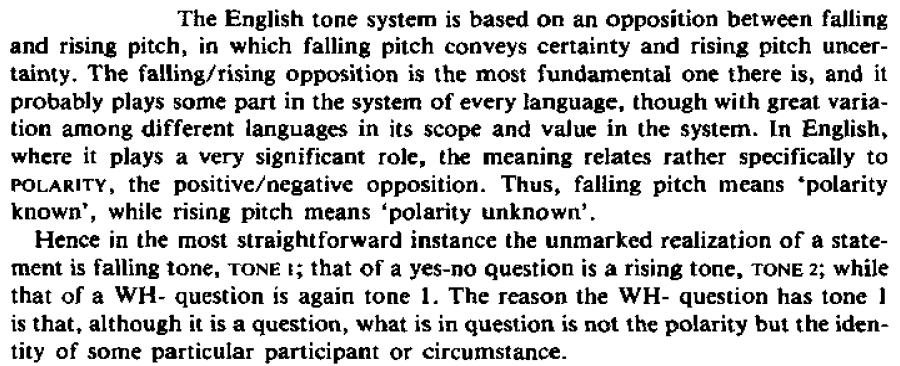
[1] To be clear, the 'certainty' realised by tone 1 is 'polarity known'. Halliday (1994: 302):

[2] This misunderstands both the text and the notion of a rhetorical question. A rhetorical question is one that does not demand information from an addressee. The question then where’s the secret well is not rhetorical, because demands from the addressee the information that would validate the proposition that she is a water witch.

05 September 2024

Problems With A Phonological Analysis

Ngo, Hood, Martin, Painter, Smith & Zappavigna (2022: 117):

The example in (1) shows paralinguistic expressions sonovergent with each major tone choice (other than the level-rise tone 3 which offers minimal phonological scope for convergent body-part movement). A phonological transcription records the tone (as, e.g. //1), and the intonation contour describes and interprets it (as, e.g. falling – ‘certain’). The paralanguage which is sonovergent with each intonation contour – which visualises it – is then described. The resonance of the visual and phonological contours adds further salience to the tonic and hence the given tone choice.


Blogger Comments
:

[1] To be clear, tone 3 is a level or low rise in pitch, so it can be realised facially by a maintained level or low rise in the eyebrows.

[2] To be clear, adding salience to the tonic is adding salience to what the tonic realises: the focus of New information, not to the tone choice that realises the system of KEY.

[3] To be clear, based on the system of KEY, the most likely tone for // I didn't / break it // is tone 2 ('protest'), not tone 4 ('reservation'), and this analysis is supported by the raised eyebrows on the clay puppet.

03 September 2024

The Problem With Interpersonal Sonovergent Paralanguage

Ngo, Hood, Martin, Painter, Smith & Zappavigna (2022: 116):

Sonovergent paralanguage is only meaningful in its relation to the prosodic phonology of co-expressed speech (Halliday, 1967, 1970a; Halliday and Greaves, 2008; Smith and Greaves, 2015) (see Chapters 1 and 3). … Where interpersonal sonovergent paralanguage resonates with tone choices it is frequently expressed in up or down movements of the head, eyebrows or arms in tune with pitch movements in co-articulated speech.


Blogger Comments:

As previously explained, sonovergent paralanguage is neither sonovergent nor paralanguage. It is not sonovergent because the bodily expressions diverge from the phonological expressions, and it is not paralanguage because it is language, since the expressions realise the grammatical system of KEY. Again, this is why it is termed 'linguistic' in Cléirigh's model, which the authors in this book rebrand as their own.

30 August 2024

Foreshadowing Problems With Chapter 5 Analyses

Ngo, Hood, Martin, Painter, Smith & Zappavigna (2022: 115):

Analyses explore the paralinguistic systems of interpersonal sonovergence in which movements of parts of the body or face rise and fall in tune with the intonation contours of the prosodic phonology and interpersonal semovergence in which paralinguistic expressions converge with interpersonal meanings in spoken discourse. … System choices are illustrated in instances from Coraline and discussion focuses on intermodal convergences in expressions of emotion and the enactment of inter-character relations.


Blogger Comments:

[1] As previously explained, sonovergent paralanguage is neither sonovergent nor paralanguage. It is not sonovergent because the bodily expressions diverge from the phonological expressions, and it is not paralanguage because it is language, since the expressions realise the grammatical system of KEY. Again, this is why it is termed 'linguistic' in Cléirigh's model, which the authors in this book rebrand as their own.

[2] As previously explained, the notion of convergence misunderstands paralanguage as an expression-only semiotic system, and the notion of semovergence entails that these expressions realise the content of language. However, since the expression of these meanings (emotions) does not require the evolution and development of language, these systems are protolinguistic, not epilinguistic, which means that the meanings that are expressed are not metafunctional (interpersonal) but microfunctional (personal).

[3] As previously observed, the data used by the authors is not the body language of humans, but representations of body language on clay puppets, as constructed by animators, using the emotion-face coding proposed by Ekman. The data are thus epilinguistic depictions of a protolinguistic system.

26 May 2024

The Semovergent Paralanguage Of PERIODICITY

Ngo, Hood, Martin, Painter, Smith & Zappavigna (2022: 39-40):

As noted in Sections 1.5.1 and 1.5.2.3, however, the vlogger does end the phase with a contrasting high then lowered pitch. The higher pitch penultimate tone group begins rhythmically speaking with a handclap foot and then a foot comprising the ‘filler’ / um /.
This is followed by the low pitch tone group; the vlogger is winding down. Following this there is a suspension of both language and paralanguage as her eyes shut and her head slumps forward (88).
The preceding phase to the one we are using to explore sonovergence here ends in a similar way (lowered pitch, with eyes shut, head down). So shutting down language and paralanguage and handing over to somasis is clearly a strategy for punctuating longer waves of discourse. It is at these points that the vlogger cuts from one filmic segment to the next (as she thinks of something more to say).

Blogger Comments:

This is recycled verbatim from Martin & Zappavigna (2019). Here are the comments from the review of Martin & Zappavigna (2019): The Semovergent Paralanguage Of PERIODICITY.

[1] As previously explained here, in this instance, the authors mistook a (misanalysed) sequence of tones (language) as voice quality (paralanguage).  On Cléirigh's original model, any gestures consistent with the tone choices are instances of linguistic body language ("sonovergent" paralanguage), not epilinguistic body language ("semovergent" paralanguage), the concern of the present discussion.

[2] Here again, as above, the authors mistake a tone choice for paralanguage, and mistake the "sonovergent" gestures that are "in tune" with the pitch movement as "semovergent".

[3] The unarguable claim here is that ending discourse ('shutting down language and paralanguage and handing over to somasis') is one way ('strategy') of ending discourse ('punctuating longer waves of discourse').

∞

More to the point, the authors are here claiming to present paralinguistic examples of "longer waves of discourse".  In Martin & Rose (2007: 187-218), these are modelled in terms of:
  • macro-Theme (introductory paragraph),
  • hyper-Theme (topic sentence),
  • hyper-New (paragraph summary), and
  • macro-New (text summary).
To be clear, the authors have not identified any of the above in the text, and have not identified any semovergent paralanguage "in sync" with them.  Instead, the authors have merely mistaken intonation as paralanguage, and interpreted the unmarked tone for declaratives, tone 1 (and accompanying gestures) as "punctuating" a longer (unnamed) wave of discourse, while ignoring all the other instances of tone 1 (and accompanying gestures) at "non-punctuating" points in the discourse.

Again, the authors have tried to fit the data to their theory, instead of using theory to account for data.

18 May 2024

Voice Quality

Ngo, Hood, Martin, Painter, Smith & Zappavigna (2022: 38):

Voice quality was noted in Section 1.5.1 in relation to the sing/song pitch (high then low) movement the vlogger uses in her last four tone groups to close down her hair dye narrative. From the perspective of APPRAISAL the sound quality resonates with her feeling that she is resigned to her current hair colour, at least for now. Work on this interpersonal aural dimension of paralanguage, drawing on van Leeuwen (1999), will be further explored in Chapter 5.


Blogger Comments:

This is recycled almost verbatim from Martin & Zappavigna (2019). Here are the comments from the review of Martin & Zappavigna (2019): Mistaking Language (Intonation) For Paralanguage (Voice Quality).

[1] Here the authors mistake prosodic features (the TONE sequence 3^13^3^1–) for a paralinguistic feature ("sing/song" voice quality).  Halliday (1985: 30-1) explains the difference as follows:
 
Moreover, if what the authors regard as "sing/song" pitch:
//3 hopefully / next ↑time I will 
//1 get my / ↓hair colour / back 
//3 um / but for / ↑now 
//3 this will / ↓do //
is compared with an accurate phonological analysis:
//3 hopefully / next time I will
//13 get my / hair colour / back
//3 um /but for / now 
//1- this will / do //
It can be seen that:
  • the first ↑ corresponds to the low-rising pitch of tone 3,
  • the first ↓ corresponds to the falling pitch of tone 1,
  • the second ↑ corresponds to the low-rising pitch of tone 3, and
  • the second ↓ corresponds to the narrow falling pitch of tone 1–

[2] To be clear, it is only the final TONE selection, tone 1–, that coincides with the APPRAISAL that the authors interpret as 'resignation' (this will do).  In SFL theory, the selection of tone 1– with declarative MOOD realises the KEY features 'mild or expected'.  Halliday (1970: 31):
Meaning of secondary tones In some cases the difference between a pair, or set, of secondary tones is mainly a matter of 'key', the degree of forcefulness or emotional intensity of the utterance. …
1. (medium), neutral; 1+ (wide), strong or unexpected; 1– (narrow), mild or expected.
On this basis, what the authors regard as voice quality "resonating" with 'resignation' is, in the authors' terms — though unknown to them — actually an instance of a secondary tone realising a feature of GRADUATION.

16 May 2024

Engagement

Ngo, Hood, Martin, Painter, Smith & Zappavigna (2022: 37-8):

Turning to ENGAGEMENT, Hao and Hood (2019) note the significance of hand position as far as supporting the expansion and contraction of heteroglossia is concerned – with supine hands opening up dialogism and prone hands closing it down. In the following example the vlogger’s supine hands converge with the modalisation probably, reinforcing acknowledgement of the viewer’s voice:

 
Two moves later the hands flip over to prone position in support of the negative move shutting down the expectation that the vlogger was in control of the new colour of her hair.


 Blogger Comments:

This is recycled verbatim from Martin & Zappavigna (2019). Here are the comments from the review of Martin & Zappavigna (2019): The Semovergent Paralanguage Of ENGAGEMENT.

[1] This is misleading; the speaker's handshape does not "converge" with modalisation probably. To be clear, the speaker's handshape is timed with the tonic hair.  The timing of the gesture thus instantiates textual linguistic body language ("sonovergent" paralanguage), highlighting hair as the focus of New information.  On this basis, the handshape instantiates ideational epilinguistic body language ("semovergent" paralanguage), realising hair.

In this first instance, the authors have again tried to make the data fit their theory, instead of using the data as a resource for theorising.

[2] This is misleading; the speaker's hands are not in a prone position — lying flat, palm downwards — in this instance.  Instead, each hand has the tips of the thumb and curved forefinger touching to form a horizontal circle, with the other fingers below them and similarly curved.  This handshape is consistent with holding an object, such as a bottle of hair dye, which would be an instance of ideational epilinguistic body language ("semovergent" paralanguage).

In this second instance, the authors have again tried to make the data fit their theory, instead of using the data as a resource for theorising.

As in the first instance above, the gestures also realise the meanings of linguistic body language ("sonovergent" paralanguage).  In terms of the textual metafunction, both hands beat down on the salient syllables not and find, highlighting both Finite and Predicator, and then on the tonic hair, marking  the Complement hair dye as the focus of New information.  In terms of the interpersonal metafunction, both hands stay level for the tonic segment (hair dye that I), in line with the level/low-rising tone choice (tone 3).  (Note that this tone group is incorrectly analysed as tone 4 by Smith, which, with declarative MOOD, would realise the KEY meaning 'reservation'.)

Lastly, the reader may also want to consider why the speaker would need to shut down the possibility of other points of view on the proposition I could not find the hair dye that I bought previously when I dyed my hair.

02 May 2024

Appreciation

Ngo, Hood, Martin, Painter, Smith & Zappavigna (2022: 34, 233):

Paralanguage deploys facial expression and bodily stance to share attitude. In (75) our vlogger nuances her appreciation (exciting) of a neighbourhood get-together she has dressed up for with raised eyebrows and a lopsided-mouth expression³¹ (which we might read as indicating that some followers might not find it all that exciting).

³¹ The ‘out-of-kilter’ mouth here can be interpreted as soft focus, converging with kind of.


Blogger Comments:

This is recycled verbatim from Martin & Zappavigna (2019). Here are the comments from the review of Martin & Zappavigna (2019): Nuancing Appreciation By (Not) Looking Surprised.

[1] Rewording this in terms of SFL theory:
In (semovergent) paralanguage, the meanings of ATTITUDE can be realised by facial expression and bodily stance.
That is, it isn't paralanguage that deploys, and the speaker enacts her attitude.

[2] The authors, after having just declared that, in terms of ATTITUDE, 'paralanguage can only enact emotion' (i.e. AFFECT and not APPRECIATION or JUDGEMENT), here present an example that, by their own terms, "resonates" with APPRECIATION.  They use term 'nuance' here to disguise the invalid claim that body language 'surprise' resonates with 'exciting'.  Moreover, as the reader can see, the facial expression does not realise the emotion 'surprise'.  Here the authors are misrepresenting the data to fit their own model.

[3] On Cléirigh's original model, the eyebrow raising here is an instance of linguistic body language (sonovergent paralanguage), not epilinguistic body language (semovergent body language).  This would be obvious if the authors had included the tone choice of the accompanying tone group, which they wrongly analyse for tonicity.  The speaker places the tonic on that's, marking it as the focus of New information, and uses tone 3 (level pitch):

//3 ^ so / that's / kind of ex/citing //

The tone group, which immediately follows an edit, begins at a high pitch and stays at that level throughout.  The eyebrows do the same, and so function the same interpersonally as the tone choice; see [4].

[4] To be clear, the "lopsided mouth" is, in this instance, merely a feature of the speaker's anatomy.

The meaning that the authors attribute to the speaker's anatomy is actually the meaning realised by her eyebrow position and tone choice.  As Halliday (1994: 305) points out, tone 3 with declarative mood can realise the KEY feature 'unimportant'.  So here the speaker's interpersonal paralanguage does not "resonate" with the positive APPRECIATION realised in wording; in fact, it contradicts it — what psychologists call 'involuntary self-disclosure'.

[5] Leaving aside the fact that the authors have attributed the meaning realised by the speaker's eyebrow position to a permanent feature of the speaker's anatomy, the authors here provide no basis whatsoever for interpreting an 'out of kilter' mouth as realising the GRADUATION feature 'soft focus'.  It is merely a bare assertion, unsupported by reasoned argument or evidence of any kind.  Readers familiar with the field of multimodality will not be surprised by this, of course.

06 April 2024

Super-Salience

Ngo, Hood, Martin, Painter, Smith & Zappavigna (2022: 25-6):

Salient syllables other than the tonic syllable can be given additional prominence (super-salience) through various means. In (14') the vlogger’s pitch on the first tone group is unusually high, and contrasts with the descending lower pitch of the following tone group (a sing/song effect). We use upward and downward arrows, ‘↑’ and ‘↓’, to signal pronounced salience of this kind.

(14''') 

//3 ↑ hopefully next / time I will
//1 get my / ↓hair colour / back //
And the vlogger’s eyebrows move up in tune and in sync with the higher pitch on / hopefully /, before lowering again by the end of the following tone group.
The same sing/song effect follows on and culminates this section of the vlog, with a high pitch on the tonic syllable / now // contrasting with the low pitch on / do //. The vlogger’s eyebrows once again move up and down in tune and in sync with the contrasting pitch salience (this time on contrasting tonic syllables).
//3 [handclap] / um /but for / ↑now 
//3 This will / ↓do //
These rhythmic in-tune gestures reinforce the attitudinal import of the RHYTHM and TONICITY.


Blogger Comments:

This is recycled verbatim from Martin & Zappavigna (2019). Here are the comments from the review of Martin & Zappavigna (2019): Misunderstanding Rhythm And Tonicity.

[1] It will be seen below that not one of syllables discussed here is a non-tonic salient syllable.

[2] Here the authors confuse the textual function of phonological prominence with the interpersonal function of pitch movement.

[3] This misunderstands the data.  The "sing/song" effect is a result of the tone sequence 3^13; see [4].

[4] This analysis misrepresents the data.  What the speaker actually intones can be phonologically represented as:
//3 hopefully / next time I  will
//13 get my / hair colour / back //
Regarding the first of these, contrary to the authors' claims, even on their own analysis, time is not a salient syllable, and listening to the data reveals that the "unusually high pitch" extends throughout the tone group, rather than just for the word time.

With regard to the second tone group, contrary to the authors' claims, hair is a tonic syllable, not a non-tonic salient syllable.  This is because hair is the first tonic in a compound tone group.

[5] This claim is manifestly untrue, since if the eyebrows stay raised for two tone groups, it is neither "in sync" with one tone group (TONALITY) nor "in tune" with the major pitch movements (TONE) of the two tone groups: level/low rise – fall – level/low rise.

This is a case of the authors misrepresenting the data in order to make them fit their misunderstandings of Cléirigh's model.

[6] This "same sing/song" effect is this time simply a result of the tone sequence 3^1-.  What the speaker actually intones can be phonologically represented as:
//3 um /but for / now //1- this will / do //
That is, the handclap co-occurs with the tonic of the previous tone group, back, and the tone of the second tone group here is a narrow fall (1-), not a level/low-rise (3).

[7] Here the authors make a brave stab at guessing what these "rhythmic in-tune" gestures might mean.  But the truth lies elsewhere.

Firstly, this is potentially misleading.  On Cléirigh's original model, it is only the rhythmic dimension or aspect of a gesture that functions textually like the rhythm of speech, and it is only the rise/fall dimension or aspect of a gesture that functions interpersonally like the pitch movement of speech.  Other dimensions or aspects of a gesture may serve additional functions.

Secondly, the notion of 'import' here derives from the work of Martinec (and possibly van Leeuwen), but the authors present it as their own.

Thirdly, the notion of attitudinal import is inappropriate here for two reasons:
  • attitude is concerned with interpersonal meaning whereas rhythm and tonicity are concerned with textual meaning, and
  • there are no instances of attitude in the instances of text under discussion.

Fourthly, as previously explained, the tonic marks the focus of New information, and the non-tonic salient syllables identify the potential foci of New information that the speaker chose not to instantiate.

29 March 2024

The Phonological System Of Tone

Ngo, Hood, Martin, Painter, Smith & Zappavigna (2022: 23):

The phonological system of TONE is realised through pitch movement. In example (56) the vlogger’s eyebrows move up in tune with the rising tone (tone 2) on the syllable prev.

 Blogger Comments:

This is recycled verbatim from Martin & Zappavigna (2019). Here are the comments from the review of Martin & Zappavigna (2019): Ignoring Content And Getting The Phonology Wrong.

To be clear, this presents Cléirigh's linguistic body language as the authors' sonovergent paralanguage, though in doing so, the authors only present the expression plane of the system, ignoring the content being realised.

Since this is linguistic body language, the interpersonal meaning that the pitch and eyebrow movement both realise depends on the grammar, the choice of MOOD, which in this instance is declarative:
//4 but /^ I could / not / find the /hair dye that I //2 bought / previously when I //3 dyed my / hair which I //3 loved I //3 loved the/ first time
On Halliday's model, the combination of tone 2 with declarative mood realises a protesting or contradicting statement (Halliday 1994: 305), as in
//2 that / can't be / true // ('so don't try and tell me!')
//2 ^ it / didn't / hurt you ('so don't make a fuss') 
In the authors' data, however, the speaker is not making a protesting or contradicting statement, and so this casts doubt on the phonological analysis. Listening to the data reveals that the pitch movement on the tonic is fairly level, tone 3.

The basic meaning of ('low-rising') tone 3, on the other hand, is that the information being realised is dependent on something else (op. cit.: 303).  In this monologic instance, it could be take to mean 'hold on, there's more to come'.  (In dialogue, tone 3 can function as a as a turn-keeping device: 'I'm not finished yet, so don't interrupt!'.) On this basis, the instance in question is better analysed as an emphatic variant of tone 3, just like the three tones that follow (and also the  preceding "tone 4").

Two trivial errors can be noted:

  • the tonic syllable is pre, not prev, and
  • a 'rise-fall' eyebrow movement corresponds to tone 5, not tone 2.

21 January 2024

A Phonological Analysis Of Tone And Tonicity

Ngo, Hood, Martin, Painter, Smith & Zappavigna (2022: 8):

(14')
// … so
//3 hopefully next / time I will
//1 get my / hair colour / back //

(15')
//3 [handclap] / um / but for / now
//3 this will / do //


Blogger Comments:

This phonological analysis first appeared in Martin & Zappavigna (2019: 9-10). See Misunderstanding Rhythm And Tonicity. The problems with the authors' analysis are as follows.

[1] In the first tone group, the tonic is on next not time:

//3 hopefully / next time I will

This also makes more sense in terms of meaning, since it identifies next as the Focus of New information (contrasting with 'last' time).

[2] In the second tone group, the tone is tone 13, not tone 1, so the analysis misses the second tonic on back:
//13 get my / hair colour / back
Importantly, the handclap coincides with this tonic the authors have missed, and so the gesture is linguistic in Cléirigh's model, realising, with the tonic, a Focus of New information. That is, the authors have missed an important instance of what they have rebranded as "sonovergent" paralanguage.

[3] In the third tone group, the only problem is the significant mistiming of the handclap: 
//3 um /but for / now
[4] In the fourth tone group, the tone is tone 1-, a narrow fall in pitch, not a tone 3, a level or low rise in pitch:
//1- this will / do //

This also makes more sense in terms of meaning, since here the speaker has completed a section of discourse, which is more consistent with tone 1 than tone 3, since tone 3 tends to signal more meaning to come, as in the previous tone group.

∞

These analyses can be verified by listening to the data here.