Showing posts with label negotiation. Show all posts

18 February 2025

Misunderstanding Emblems As An Expression Form Of Language

Ngo, Hood, Martin, Painter, Smith & Zappavigna (2022: 203, 204):

In reviewing our proposals for sonovergent and semovergent systems, it is important to keep in mind that we are treating emblems as part of the expression form of language and not as paralanguage (Figure 7.4) – and thus excluded thumbs-up or thumbs-down (as praise or censure), index finger touching lips (for ‘quiet please’), hand cupped over ear (for ‘I can’t hear’) and so on from our description. Our reasoning was presented in Chapter 1, Section 1.6. This was the basis of our argument that semovergent paralanguage cannot be used to support NEGOTIATION by distinguishing move types in dialogic exchanges (although sonovergent paralanguage can of course support tone choice in relation to these moves).


Blogger Comments:

[1] To be clear, emblems involve both content and expression, and so are not merely an expression form. Moreover, they are not language because their content plane is not stratified into semantics and grammar. Instead, the use emblems requires the prior evolution and development of language, as demonstrated by the fact that other species do not use them, and so are classified as 'epilinguistic' in Cléirigh's model, which does indeed make them 'semovergent' in the authors' model. See also the previous post: Emblems As Language Expressions.

[2] Figure 7.4 misrepresents all language content as 'form'. To be clear, the only form on the content plane is the formal constituency of grammar: clause, phrase, group, word, morpheme.

[3] See the previous post: The Argument That 'Emblems' Are Part Of Language.

[4] To be clear, the authors (p202) have themselves presented an instance of a move type, a gestured command, but failed to recognise it as a SPEECH FUNCTION:

She then mimes his ideational paralanguage as he twice gestures for her to leave (including a deictic pointing gesture).

05 June 2024

The Argument That 'Emblems' Are Part Of Language

Ngo, Hood, Martin, Painter, Smith & Zappavigna (2022: 42):

These gestures differ from the semovergent ones illustrated thus far in critical ways (cf. McNeill, 2012: 7–10). For one thing they commit very specific meanings and can be readily recognised without accompanying co-text (linguistic or paralinguistic). As part of this specificity they can enact moves in exchange structure on their own, for example, statements and requests, alongside greetings and leave-takings (hand waving), calls (beckoning gestures), agreement (nodding head), disagreement (shaking head), challenges (upright palm facing forward for ‘stop’) and so on. For another they are the first thing that comes to mind when someone mentions gesture. And in this regard they are often commented on as culturally specific (e.g. the difference between an Anglo supine hand beckoning gesture and its Filipino prone hand equivalent). In both respects emblems contrast with common-sense dismissals of the paralanguage as idiosyncratic (although none of us has any trouble successfully interpreting another speaker’s sonovergent and semovergent systems). From the perspective of the sign languages of the deaf, emblems most strongly resemble signs; they are expression form gestures explicitly encoding meaning. Similarly, from the perspective of character-based writing systems (such as those of Chinese), emblems most strongly resemble characters (but gestured rather than scribed). 
This indicates that from an SFL perspective emblems are better treated as part of language than as a dimension of paralanguage.


 Blogger Comments:

This is recycled almost verbatim from Martin & Zappavigna (2019). Here are the comments from the review of Martin & Zappavigna (2019): The Argument That 'Emblems' Are Part Of Language.

To be clear, here the authors outline their argument for classifying what Kendon terms 'emblems' as language rather than semovergent paralanguage (Cléirigh's epilinguistic body language).

[1] Incidentally, here the authors exemplify the use the word one as a constituent of a conjunctive Adjunct; see the preceding post on the vlogger gesturing the meaning 'one'.

[2] To be clear, in SFL theory, unknown to the authors, the conventionalisation of the meaning of specific gestures in a community corresponds to the move of the sign (content/expression pair) from the instance pole to the system pole of the cline of instantiation.  However, since this can occur in the development of semiotic systems in general — e.g. protolanguage, emoji, pictorial signage — it does not support the authors' argument that emblems are part of language.

[3] To be clear, gestures don't "commit" meanings, they realise them, since realisation is the relation between expression and content.  'Commitment', on the other hand, in Martin's own terms, is concerned with  instantiation, the relation between potential and instance, though, as previously explained here, the notion derives from Martin's misunderstanding of systemic delicacy.

[4] To be clear, here the authors have switched attention from tone groups to exchange structures in an attempt to fudge their argument.  In their own terms, these moves would constitute examples of interpersonal semovergent paralanguage, since the meaning of these gestures "resonates" or "converges" with the meanings of Martin's interpersonal discourse semantic system of NEGOTIATION.  Accordingly, this does not support the authors' argument that emblems are part of language.

[5] The authors' "argument" here is that because these gestures are regarded as prototypical gestures, they are therefore part of language.

[6] To be clear, on the one hand, some emblems are culturally-specific and some are not.  So culture specificity cannot be used as an argument about emblems as a type.  On the other hand, in any case, the culture-specificity of semiotic systems is not confined to language, as demonstrated, for example, by differences in the protolanguages of separated populations of the same species.

[7] To be clear, Halliday (1989: 30-1) distinguishes paralanguage from indexical features, the latter being those that are peculiar to the individual ("idiosyncratic").  So the authors' argument here is that  emblems are language because they are not indexical features.

[8] As this blog demonstrates, the authors do have trouble in interpreting both the meaning of the vlogger gestures and the type of body language involved.

[9] To be clear, the authors' argument here is that emblems are part of language because their expressions resemble the expressions of language (Sign and Chinese), and that, in the case of one of these, at least, the expressions "explicitly encode" meaning.

On the one hand, if this is true, it applies to all languages, not just Sign and Chinese.  On the other hand, the reason it is not true is that the expressions of Sign and Chinese, encode the wording that encodes meaning, whereas the expressions of emblems only encode meaning.  That is, Sign and Chinese, being languages, are tri-stratal, whereas emblems, not being language, are bi-stratal.  Once again, the authors' argument does not support their claim that emblems are part of language.

[10] As the above clarifications demonstrate, not one of the arguments offered by the authors supports their hypothesis that emblems are part of language.

20 May 2024

Textual Semovergent Paralanguage

Ngo, Hood, Martin, Painter, Smith & Zappavigna (2022: 38, 233):

From a textual perspective³² we need to take into account how spoken language introduces entities and keeps track of them once there (IDENTIFICATION) and how it composes waves of information in tone groups, clauses and beyond (PERIODICITY). Semovergent paralanguage potentially supports these resources with pointing gestures and whole body movement and position.

³² Martinec (1998) interprets textual meaning as realised through cohesion, following Halliday and Hasan (1976); as introduced earlier for this monograph we follow Martin (1992) who reinterprets cohesion as discourse semantics (Martin, 2014), organised metafunctionally in Martin and Rose ([2003] 2007) as ideational resources (IDEATION, CONNEXION), interpersonal resources (NEGOTIATION, APPRAISAL) and textual resources (IDENTIFICATIONPERIODICITY).


Blogger Comments:

This is recycled almost verbatim from Martin & Zappavigna (2019). Here are the comments from the review of Martin & Zappavigna (2019): Textual Semovergent Paralanguage.

[1] To be clear, despite this claim, it will be seen that the authors provide no instances of semovergent paralanguage in this paper that either introduce entities or keep track of them.

Moreover, IDENTIFICATION is Martin's rebranding of Halliday and Hasan's (1976) grammatical cohesive systems of REFERENCE and ELLIPSIS-&-SUBSTITUTION, misunderstood, confused with ideational denotation and the interpersonal DEIXIS of nominal group structure, and relocated to discourse semantics; evidence here.

[2] To be clear, on the one hand, this confuses content (information) with expression (tone group), following Martin (1992: 384).  On the other hand, on Cléirigh's original model, any aspect of body language that highlights the focus of New information, or delineates a unit of information, functions as linguistic body language ("sonovergent" paralanguage), not epilinguistic body language ("semovergent" paralanguage).

[3] To be clear, PERIODICITY is Martin and Rose's (2003, 2007) reinterpretation of what Martin (1992: 393) models as interstratal interaction patterns as a textual systems of Martin's discourse semantic stratum.  However, Martin's model misrepresents writing pedagogy as linguistic theory, such that:
  • introductory paragraph is rebranded as macro-Theme,
  • topic sentence is rebranded as hyper-Theme,
  • paragraph summary is rebranded as hyper-New, and
  • text summary is rebranded as macro-New.
It will be seen that, unsurprisingly, the authors provide no instances of semovergent paralanguage in this paper that 'compose waves of information', let alone gestural realisations of introductory paragraphs, topic sentences, paragraph summaries or text summaries.

[4] To be clear, here Martin and his former student follow Martin (1992) in rebranding misunderstandings Halliday & Hasan's (1976) non-structural textual systems of lexicogrammar as structural discourse semantic systems across three metafunctions.

[5] To be clear, IDEATION is Martin's rebranding of Halliday and Hasan's (1976) textual system of LEXICAL COHESION, misunderstood, confused with logical relations between experiential elements of nominal group structure, also misunderstood, and relocated to discourse semantics as an experiential system; evidence here.

[6] To be clear, CONNEXION does not feature in Martin and Rose (2007), or in Martin (1992). The term 'CONNEXION' is a rebranding of Martin's CONJUNCTION by Martin's former student, Hao. CONJUNCTION is Martin's misunderstanding of Halliday and Hasan's (1976) textual lexicogrammatical system of cohesive conjunction as a logical system at the level of discourse semantics.  Moreover, it confuses non-structural textual relations with structural logical relations, and misunderstands and misapplies the expansion relations involved; evidence here.

That is to say, CONJUNCTION was the only one of Halliday and Hasan's cohesive systems that Martin neglected to rebrand as his own system, and this oversight was finally addressed by his former student.

[7] To be clear, NEGOTIATION is Martin's (1992) rebranding of Halliday's SPEECH FUNCTION.

01 March 2024

Negotiation: Meaning Beyond The Clause

Ngo, Hood, Martin, Painter, Smith & Zappavigna (2022: 15):

In terms of meaning beyond the clause NEGOTIATION allows us to relate moves in conversation, including moves comprising several clauses (as in the following request and compliance sequence):
(42)
Tell us why you left the parking lot.
⇓⇑
- I had just got in my car, got my phone and as I was doing that some guy was sitting there and there was cars behind him and he was like [mimics man’s gesture and expression] like waving me out.


Blogger Comments:

To be clear, NEGOTIATION "allows us" linguists to group moves in conversation — in terms of initiation and response.

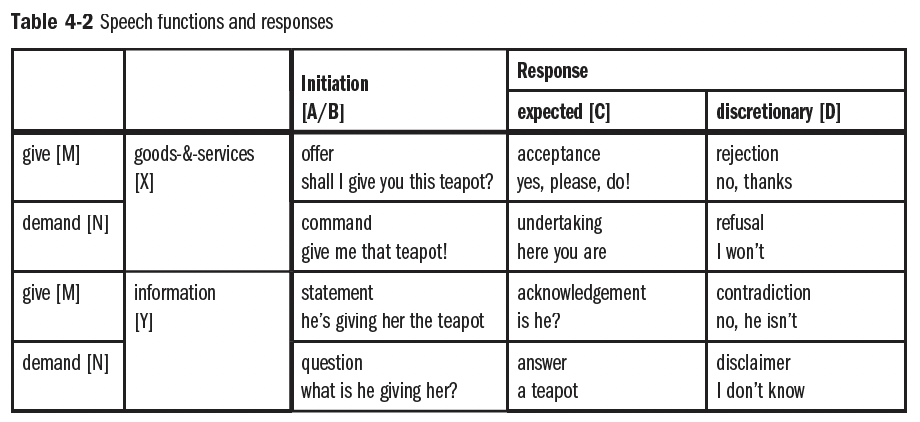
As previously noted, NEGOTIATION is Martin's rebranding of Halliday's SPEECH FUNCTION. The system and types of response are provided in Halliday & Matthiessen (2014: 136-7):


Importantly, there is no interpersonal meaning 'beyond the clause' in this constructed example. That is, the interpersonal meaning of the initiating move, a command, realised by a clause, does not extend beyond into the responding move, an undertaking, realised by a clause complex. Any meaning 'beyond the clause' is realised by the textual system of cohesion.

28 February 2024

Negotiation: Grammatical Metaphor

Ngo, Hood, Martin, Painter, Smith & Zappavigna (2022: 15):

In terms of grammatical metaphor NEGOTIATION allows us to realise moves directly, or metaphorically through so-called indirect speech acts:
(39)
What’s his name? (congruent interrogative clause requesting information)
- Andy. 
(40)
Tell me his name. (metaphorical imperative clause requesting information)
- Andy. 
(41)
His name is? (metaphorical declarative clause requesting information)
- Andy.


Blogger Comments:

[1] This misunderstands grammatical metaphor. To be clear, NEGOTIATION (Halliday's SPEECH FUNCTION) does not enable ("allow") moves to be realised congruently ("directly") or metaphorically by the grammatical system of MOOD. That is, SPEECH FUNCTION is not the Agent of realisation but the Medium or Range of the realisation.

[2] To be clear, the technical term here is demand, not request. A request is typically a command: a demand for goods-&-services.

[3] To be clear, this metaphorical clause realises a demand for a service: a process of saying (tell).

[4] To be clear, this metaphorical clause deploys cohesion: the ellipsis of the Identified/New after presenting the Identifier as Theme.

26 February 2024

Negotiation: Lexicogrammatical Diversification

Ngo, Hood, Martin, Painter, Smith & Zappavigna (2022: 14-5):

The key interpersonal systems are NEGOTIATION and APPRAISAL. NEGOTIATION comprises resources for enacting social relations in dialogue. In terms of diversification it allows us, for example, to realise greeting moves through a range of more and less lexicalised structures:

(33) Hi everybody.
(34) Good morning.
(35) How’s it going?
(36) What a surprise!
(37) Lovely to see you!
(38) Didn’t know you were back in town.


Blogger Comments:

To be clear, NEGOTIATION — Martin's rebranding of Halliday's SPEECH FUNCTION — doesn't "allow" us to realise greetings grammatically, since higher strata do not "allow" lower strata; meaning does not "allow" wording in any sociosemiotic species. The realisation relation between strata is one type of elaborating identity: symbolic abstraction.

To be clear, greetings are a minor speech function which may be realised by nominal groups, minor clauses (with no mood structure) or major clauses. It is only when a greeting is realised by a major clause that it is constructed as a proposition or proposal, and so as negotiable. See Halliday & Matthiessen (2014: 127, 195-6).